
Introduction
A quality aquarium filter is the single most important piece of equipment for keeping your fish healthy and your water crystal clear. Yet many beginners struggle to choose the right filter system, leading to cloudy water, sick fish, and frustration that makes them want to give up on fishkeeping entirely.
I’ve been there. My first aquarium was a disaster until I learned that not all filters are created equal. After years of experience and extensive research into the best aquarium filters available today, I’ve created this comprehensive guide to help you avoid the mistakes I made and set up a thriving aquarium from day one.
Whether you’re setting up your first 10-gallon betta tank or a 55-gallon community aquarium, this guide will help you find the perfect filtration system for crystal-clear water and happy, healthy fish.
Why Your Filter Choice Matters
Before diving into specific products, understand why filtration is critical:
- Removes Waste: Filters remove fish waste, uneaten food, and debris
- Biological Filtration: Beneficial bacteria convert toxic ammonia to safer compounds
- Water Clarity: Mechanical filtration removes particles for clear water
- Oxygen Circulation: Creates water movement for proper oxygenation
- Fish Health: Clean water prevents diseases and stress
- Less Maintenance: Good filters reduce how often you need to clean
The Golden Rule: Your filter should cycle the entire tank volume 4-5 times per hour. For a 20-gallon tank, you need a filter rated for at least 80-100 gallons per hour (GPH).
Types of Aquarium Filters Explained
Understanding filter types helps you choose correctly:
Hang-On-Back (HOB) Filters
Most popular for beginners. Hang on the back of the tank, easy to maintain, good for most aquarium sizes.
Canister Filters
External filters under the cabinet. Powerful filtration, best for large tanks, more expensive but excellent performance.
Sponge Filters
Air-powered, gentle filtration. Perfect for small tanks, fry tanks, or hospitals. Inexpensive and safe for delicate fish.
Internal Filters
Submersible filters inside the tank. Good for small tanks, less powerful than HOB or canister options.
Under-Gravel Filters
Old-school design, now less popular. Water flows through gravel substrate for filtration.
What to Look for in an Aquarium Filter
Here are the key features I prioritized:
- Flow Rate (GPH): Should turn over tank volume 4-5x per hour
- Tank Size Rating: Match to your aquarium size or go slightly larger
- Filtration Stages: Mechanical, biological, and chemical filtration
- Adjustable Flow: Important for delicate fish like bettas
- Noise Level: Quiet operation won’t disturb you
- Ease of Maintenance: Simple media replacement and cleaning
- Reliability: Quality brands with good warranties
- Value: Performance worth the price
Top 5 Best Aquarium Filters for Beginners
1. Best Overall: AquaClear Power Filter
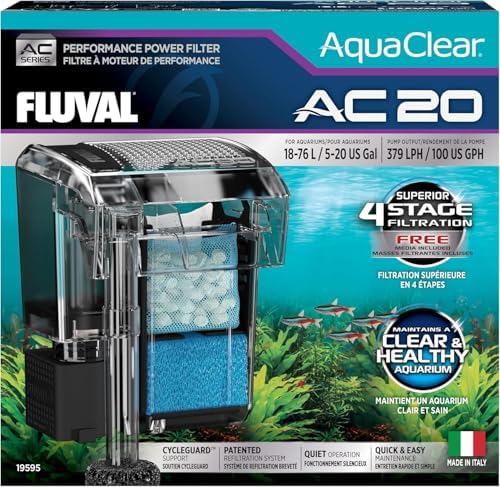
- Aquarium filtration system that offers superior contact time with filter media and energy efficient pump lowers operatin…
- Quick and easy installation; we recommend that you clean aquarium filter every 2 weeks for maximum operation and efficie…
- Provides optimal mechanical; chemical; and biological filtration
After testing numerous filters over the years, AquaClear consistently delivers the best performance and value for beginners. Available in multiple sizes, there’s an AquaClear for virtually any tank.
Why We Love It:
- Available in 5 sizes: 20, 30, 50, 70, 110 (for tanks 5-110 gallons)
- Powerful filtration with up to 7x water turnover per hour
- Unique patented re-filtration system maximizes contact time
- Adjustable flow control (perfect for bettas and gentle fish)
- Three-stage filtration (mechanical, chemical, biological)
- Uses foam, carbon, and BioMax media
- Easy media replacement (affordable long-term)
- Extremely reliable (can run for years)
- Energy efficient
- Quiet operation
- Backed by excellent warranty
Best For: Beginners to experienced keepers, most tank sizes, community tanks, adjustable needs
Potential Drawbacks: Slightly higher upfront cost than basic filters (worth it for performance)
Price Range: $30-$80 (depending on size)
2. Best Budget Filter: Tetra Whisper Power Filter

- QUIET AQUARIUM FILTER: The Tetra Whisper IQ Power Filter with Stay Clean technology contains a sound shield for quiet fi…
- SELF PRIMING: Submerged motor starts up with no priming required.
- CAPACITY: The Tetra Whisper IQ 20 Power Filter works in filters up to 20 gallons (130 GPH).
Not everyone can invest heavily in their first aquarium. The Tetra Whisper delivers solid filtration performance at a beginner-friendly price point.
Why We Love It:
- Very affordable for most budgets
- Available in multiple sizes (10i, 20i, 30i, 40i, 60i)
- Extremely quiet operation (lives up to “Whisper” name)
- Easy drop-in cartridge system (beginner-friendly)
- Three-stage filtration
- Continuous water flow even during cartridge changes
- Reliable Tetra brand quality
- Uses Bio-Bag cartridges with activated carbon
- Good for tanks 10-60 gallons
- Energy efficient
Best For: First-time fishkeepers, budget-conscious beginners, small to medium tanks
Potential Drawbacks: Replacement cartridges can be expensive long-term (consider refillable media), not as powerful as premium options
Price Range: $15-$40 (depending on size)
3. Best for Large Tanks: Fluval 07 Series Canister Filter
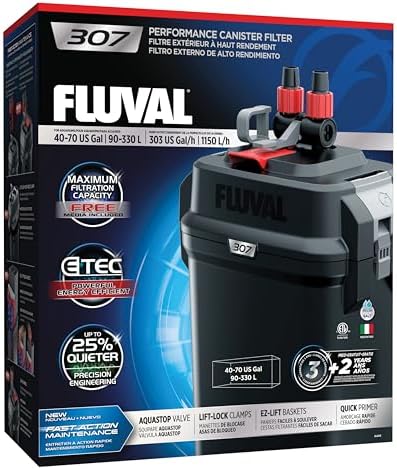
- Efficient Aquarium Canister Filter: Fluval eTEC technology delivers powerful pump performance and ultra-quiet operation;…
- Reliable Aquarium Filter: Powerful motor generates constant pumping power and pressure; ensures healthy and clean fish t…
- Silent Fish Tank Filter: Precision-crafted pump runs up to 25% quieter than previously; perfect choice for pet owners lo…
Once you move beyond 40-50 gallon tanks, canister filters become the best choice. The Fluval 07 series offers exceptional filtration for larger aquariums.
Why We Love It:
- Available for tanks 40-100+ gallons (107, 207, 307, 407 models)
- Multi-stage filtration with large media capacity
- Smart pump technology adjusts flow automatically
- Extremely quiet operation
- Easy lift-lock clamps for maintenance
- Aqua-Stop valve prevents spills during cleaning
- Self-priming for easy startup
- Energy efficient
- Stackable media baskets for customization
- Powerful flow rates (up to 383 GPH on 407 model)
- Ball valve output control
Best For: Tanks 40+ gallons, advanced beginners, planted tanks, messy fish like goldfish or cichlids
Potential Drawbacks: Higher price point, requires space under tank, slight learning curve for first-time canister users
Price Range: $140-$280 (depending on model)
4. Best for Betta Tanks: Hygger Aquarium Sponge Filter

- 【Multi-filtration functions】this sponge aquarium filter combines bio-filtration, oxygenation and physical filtration in …
- 【Filter Demension】plus the sponge filter with media balls takes up no more room. Small filter is 6″ in width and 9″ to 1…
- 【Package Includes】1 double sponge filter with 2 containers +1 bag of ceramic media balls + 2 pare sponges(packed in the …
Betta fish and other delicate species need gentle filtration. Strong currents stress them out. Sponge filters provide perfect gentle flow while maintaining excellent biological filtration.
Why We Love It:
- Ultra-gentle flow perfect for bettas, fry, shrimp
- Excellent biological filtration (entire sponge is bio-media)
- Won’t suck up small fish or shrimp
- Very affordable
- Available in multiple sizes (nano to 40 gallon)
- Easy to clean (just squeeze in old tank water)
- Biochemical sponge provides large surface area for beneficial bacteria
- Increases oxygen through air bubbles
- Nearly silent operation
- Requires air pump (sold separately or in kits)
- Long-lasting (sponges last years)
Best For: Betta tanks, nano tanks (5-10 gallons), fry tanks, shrimp tanks, hospital tanks
Potential Drawbacks: Requires separate air pump, not powerful enough for large tanks or heavy bioloads
Price Range: $8-$20 (plus air pump $10-20)
5. Best All-in-One: Marineland Penguin Power Filter

- WITH ROTATING BIO-WHEEL: Patented Bio-Wheel technology provides excellent wet/dry biological filtration.
- MULTI-STAGE FILTRATION: Delivers mechanical, chemical and biological aquarium filtration to maintain a clean aquatic env…
- MARINELAND FILTRATION PRODUCTS: Count on Marineland brand for the most reliable, technically advanced aquariums and acce…
The Marineland Penguin combines ease of use with effective filtration, making it ideal for beginners who want simplicity without sacrificing quality.
Why We Love It:
- Available in multiple sizes (75, 150, 200, 350 GPH models)
- BIO-Wheel technology for superior biological filtration
- Rotating wheel provides constant bacteria contact with oxygen
- Three-stage filtration system
- Easy cartridge replacement
- Adjustable mid-level intake strainer
- Filters water at top and bottom simultaneously
- Quiet operation
- Reliable performance
- Good value for money
- Trusted Marineland brand
Best For: Beginners wanting reliable, easy maintenance, tanks 10-70 gallons, community tanks
Potential Drawbacks: BIO-Wheel can be noisy if water level drops, replacement cartridges add up over time
Price Range: $20-$50 (depending on size)
Understanding the Nitrogen Cycle
Your filter is crucial for the nitrogen cycle – the most important concept in fishkeeping:
Step 1: Fish produce ammonia through waste (highly toxic) Step 2: Beneficial bacteria convert ammonia to nitrite (still toxic) Step 3: Different bacteria convert nitrite to nitrate (less harmful) Step 4: Water changes remove nitrate buildup
Your filter’s job: House beneficial bacteria that perform steps 2 and 3. This is called “biological filtration” and takes 4-6 weeks to establish in new tanks.
Critical for beginners: Never replace all your filter media at once! This removes beneficial bacteria and crashes your cycle, potentially killing fish. Replace media gradually or rinse existing media in old tank water.
Filter Maintenance Guide
Keep your filter running optimally:
Weekly Tasks:
- Check water flow (reduced flow means clogging)
- Observe for unusual noises
- Ensure intake and output clear of debris
Bi-Weekly to Monthly:
- Rinse mechanical media (sponges/foam) in old tank water
- Check impeller for debris (canister filters)
- Top off water to maintain proper filter operation
Monthly to Bi-Monthly:
- Replace chemical media (activated carbon)
- Clean intake tube and output nozzle
- Inspect for wear or damage
As Needed:
- Replace worn sponges/foam (usually 3-6 months)
- Never replace biological media unless damaged
- Replace cartridges per manufacturer instructions
Pro Tip: Always rinse filter media in OLD aquarium water during water changes, never tap water. Chlorine in tap water kills beneficial bacteria!
Common Beginner Filter Mistakes
Avoid these frequent errors:
- Undersized Filter: Always match or exceed recommended tank size
- Replacing All Media at Once: Crashes your biological cycle
- Over-Cleaning: Excessive cleaning kills beneficial bacteria
- Using Tap Water to Rinse Media: Chlorine destroys good bacteria
- Forgetting to Turn Off During Feeding: Some fish stress with strong current
- Not Using Filter During Cycling: Filter needs to run 24/7 to establish bacteria
- Buying Based on Price Alone: Cheap filters often fail quickly or underperform
Matching Filter to Fish Type
Different fish have different filtration needs:
Betta Fish & Gouramis
Need gentle flow. Use adjustable filters, sponge filters, or add baffles to reduce current.
Goldfish & Cichlids
Messy fish producing lots of waste. Need powerful filtration – oversized HOB or canister recommended.
Community Tropical Fish
Standard filtration works well. Match filter rating to tank size.
Shrimp & Small Fish
Need gentle filtration that won’t suck them up. Sponge filters are ideal.
Planted Tanks
Moderate flow best – too much current uproots plants. Canister filters or adjustable HOB.
Boosting Your Filter’s Performance
Get even better results:
- Add Extra Media: Many filters have space for additional sponges or bio-media
- Pre-Filter Sponge: Slip over intake to catch large debris and protect small fish
- Baffle the Output: Reduce flow for delicate fish using baffles or lily pipes
- Dual Filtration: Run two smaller filters instead of one large (backup if one fails)
- Surface Skimmer: Attachment removes surface film for clearer water
- Custom Media: Replace cartridges with refillable media bags (save money long-term)
Final Thoughts
A quality filter is the foundation of a successful aquarium. My top recommendation for beginners is the AquaClear Power Filter for its perfect balance of performance, adjustability, and value. It’s powerful enough for most setups while gentle enough for sensitive fish when flow is adjusted.
However, choose based on your specific needs:
- Tight budget? Tetra Whisper gets the job done
- Large tank (40+ gallons)? Fluval 07 canister is worth the investment
- Betta or nano tank? Hygger sponge filter is perfect
- Want simple maintenance? Marineland Penguin with BIO-Wheel
Remember: the filter you choose today will determine your success or frustration as a fishkeeper. Invest in quality filtration from the start, and you’ll enjoy crystal-clear water and healthy fish for years to come!
What filter do you use in your aquarium? Share your experience in the comments!
Frequently Asked Questions
Q: How long should I run my aquarium filter? A: 24/7, every day. Your filter houses beneficial bacteria that need constant water flow and oxygen. Turning it off even briefly can cause bacteria die-off.
Q: Can a filter be too powerful for my tank? A: Yes! Too much flow stresses fish and makes swimming difficult. Look for filters with adjustable flow or choose appropriately sized filters.
Q: How do I know if my filter is working properly? A: Check for consistent water flow, bubbles/ripples at surface, and no unusual noises. Your water should be clear (after initial cycle period).
Q: When should I replace my filter completely? A: Quality filters can last 5-10+ years with proper maintenance. Replace if motor fails, housing cracks, or parts are no longer available.
Q: Do I need to “cycle” my filter before adding fish? A: You cycle the entire tank (filter included) for 4-6 weeks before adding fish. This establishes beneficial bacteria. Consider fishless cycling for humane setup.
Q: Can I turn off my filter at night? A: No! Your filter must run 24/7. Beneficial bacteria need constant oxygen and will begin dying within hours of the filter being off.
Affiliate Disclosure
Transparency Note: PawPicks is a participant in the Amazon Services LLC Associates Program, an affiliate advertising program designed to provide a means for sites to earn advertising fees by advertising and linking to Amazon.com.
When you purchase through links in this article, we may earn a small commission at no additional cost to you. This helps us continue creating comprehensive, free guides for aquarium hobbyists like you.
We only recommend aquarium filters we genuinely believe are safe, effective, and beneficial for fish health. Our reviews are based on extensive research, personal experience, customer feedback analysis, and understanding of aquatic ecosystems. We never let affiliate relationships influence our honest opinions.
Your fish’s health and your success as an aquarist are our top priorities. We’re committed to helping you build a thriving aquarium with the right equipment.
Thank you for supporting PawPicks by using our links!